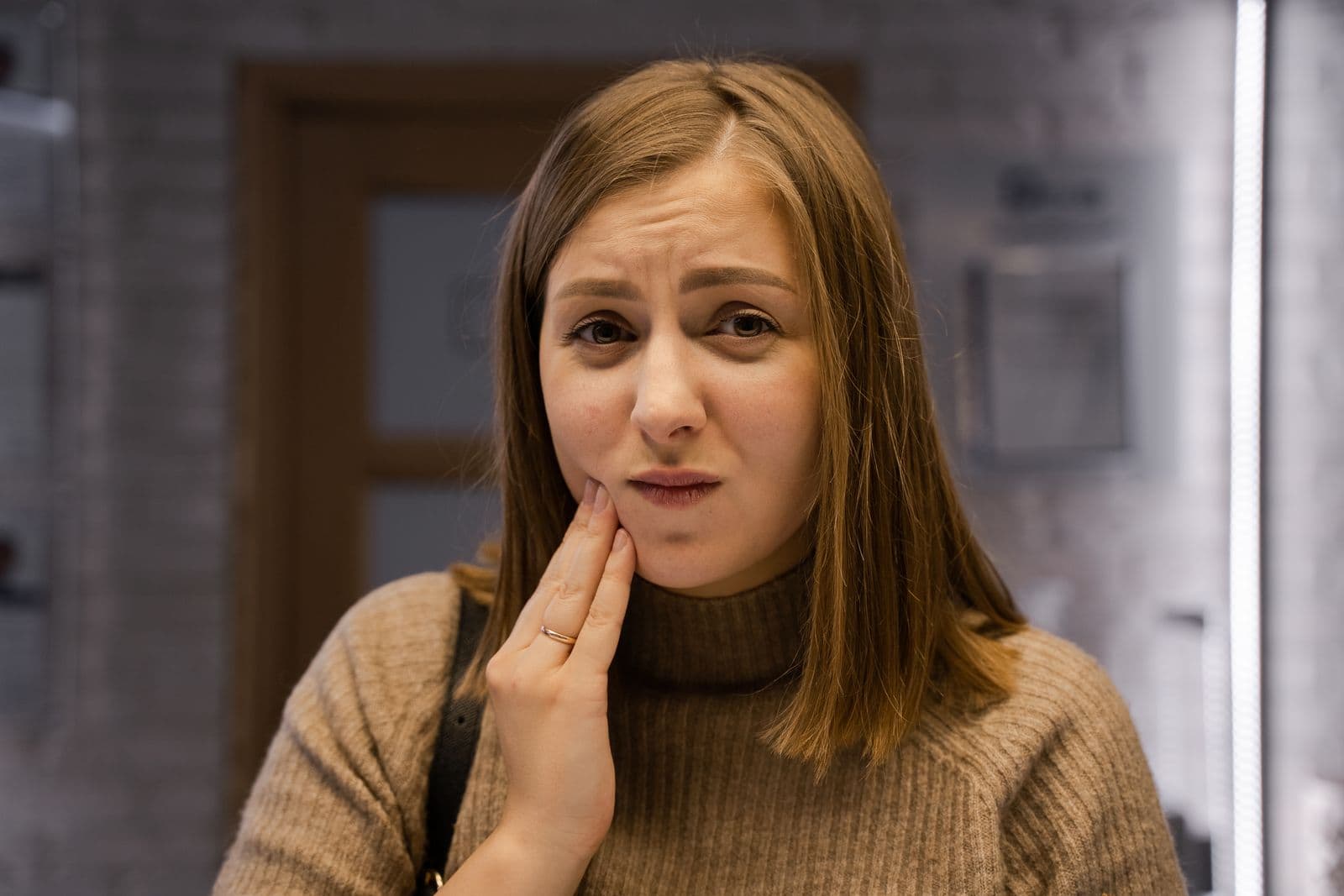
Why Does My Tooth Hurt When I Chew?
Pain when chewing: cracked tooth, deep cavity, failing filling or crown, abscess, gum disease, or sinus pressure — and when to see a dentist.
Share with a colleague
Have a question about your own teeth?Free
Ask usQuick answer: pain when you chew usually points to one of a handful of causes — a cracked tooth, decay that has reached deep into the tooth, a loose or failing filling or crown, an infection at the root tip, or gum disease that has weakened the tooth's support. Less often, sinus congestion is felt as upper back tooth pain. The exact cause determines the treatment, so have it checked rather than avoiding that side of your mouth indefinitely (Yu et al., 2022).
The most common causes#
Cracked tooth#
Sharp pain specifically when biting down — especially when you release the bite — is the hallmark sign of a cracked tooth. Cracks are often invisible to the naked eye, which is why the pain can seem to come from a tooth that looks perfectly normal (Yu et al., 2022). Chewing on something hard, clenching, or grinding are the usual triggers.
A crack will not heal on its own, because enamel and dentin cannot repair themselves. Treatment binds the tooth together before the crack spreads: a crown or bonded restoration when the crack is confined to the crown of the tooth, and root canal treatment if it has reached the nerve. A systematic review of endodontically treated cracked posterior teeth found root canal treatment to be a suitable option for saving them, with survival dependent on restoring the tooth properly afterward (Olivieri et al., 2020). With no sign of infection, pain on biting with no infection covers this exact pattern in depth.
Deep cavity#
Decay that approaches or reaches the tooth's nerve often hurts under pressure, not just with hot or cold. Bacterial stimuli from a deep lesion progressively inflame the pulp, and that inflammation is what makes the tooth tender to chew on (Schwendicke et al., 2026). A deep cavity can still be treated with a filling or crown if the nerve is healthy, but once the inflammation becomes irreversible the tooth needs root canal treatment or extraction.
Failing filling or crown#
An old filling or crown that has loosened, cracked, or developed a gap at its edge can let bacteria in underneath, and chewing on it drives pressure toward those newly exposed surfaces. Restoration failures accumulate over time: in one practice-based follow-up of posterior composite restorations running up to 33 years, restorations kept failing at a steady rate decades after placement, with new decay at the restoration margin and fracture the leading reasons (Da Rosa Rodolpho et al., 2022).
Abscess or infection#
An infection at the root tip inflames the ligament that suspends the tooth, which is why the tooth feels "high" and tender specifically under pressure. It often throbs, reacts to heat, and is tender to tapping. If you are unsure what you are looking at, how to identify an oral abscess covers the warning signs. Antibiotics alone do not fix the problem; the ADA guideline is explicit that definitive dental treatment, not antibiotics, is the priority (Lockhart et al., 2019). An untreated abscess keeps spreading, so this cause should not wait.
Gum disease#
When the bone and ligament supporting a tooth are compromised by gum disease, the tooth can feel sore or shift slightly under the pressure of chewing. Periodontitis is defined by exactly this loss of attachment around the tooth (Papapanou et al., 2018), and chewing discomfort alongside loose teeth, receding gums, or bleeding when brushing points there. The good news is that early gum disease can be reversed with professional cleaning and home care.
Sinus pressure#
The roots of the upper back teeth sit just below the maxillary sinus, with overlapping nerve supply. Sinus congestion or infection can be felt as pain in several upper back teeth at once, typically worse when bending forward or when you have a cold — and the traffic runs both ways, since infected upper teeth can also seed sinusitis (Craig et al., 2024). The clue it is sinus rather than tooth: several upper teeth ache at once, and chewing does not sharpen the pain.
What to do#
Stop chewing on the affected side and schedule a dental exam with an X-ray. The diagnosis usually takes a bite test, transillumination with a light, removal of an old filling, or occasionally a small-volume CT scan, because cracks in particular are hard to see on standard films (Yu et al., 2022). Pain with chewing is rarely something that resolves on its own, and early treatment is easier and more tooth-preserving: a small crack or early decay is a restoration, while a neglected one can become nerve damage or tooth loss (Olivieri et al., 2020).
Sharp or worsening pain, swelling, or pain with fever should not wait for a routine slot — what counts as a dental emergency applies the moment those signs appear.
Frequently asked follow-ups#
Is chewing pain always a sign of a serious problem?#
Not always an emergency, but rarely something to ignore. Even a small crack or early infection is far easier to treat before it progresses.
Can a cracked tooth heal on its own?#
No. Tooth structure cannot regenerate, so treatment aims to bind and protect the tooth before the crack extends.
Should I see a dentist right away or can it wait?#
If the pain is sharp, worsening, or accompanied by swelling, do not wait. Otherwise, book a prompt exam within days rather than hoping it resolves on its own.
Key takeaways#
- Chewing pain most often points to a crack, deep cavity, failing restoration, or root infection.
- Gum disease and even sinus pressure can also produce pain that feels like it is coming from a tooth.
- A dental exam with X-rays is needed to identify the exact cause; chewing pain rarely resolves on its own.
- Sharp, worsening pain or swelling means do not wait to be seen.
This article is for general educational purposes and does not replace a personalized evaluation from a dental professional.
Share with a colleague
Ask a dental question
Still have a question?
Free. Answers from published research, then book a visit with a verified local dentist.
- Why does my tooth hurt to bite down?
- Can a cracked tooth heal on its own?
- Is chewing pain a dental emergency?
Citations
- Yu, M., Li, J., Liu, S., Xie, Z., Liu, J., & Liu, Y. (2022). Diagnosis of cracked tooth: Clinical status and research progress. The Japanese Dental Science Review, 58, 357–364.
- Olivieri, J. G., Elmsmari, F., Miró, Q., Ruiz, X. F., Krell, K. V., García-Font, M., & Durán-Sindreu, F. (2020). Outcome and Survival of Endodontically Treated Cracked Posterior Permanent Teeth: A Systematic Review and Meta-analysis. Journal of Endodontics, 46(4), 455–463.
- Schwendicke, F., Kosan, E., Banerjee, A., et al. (2026). Deep caries management: EFCD-ESE-ORCA S3-level clinical practice guideline. Clinical Oral Investigations, 30(5), 186.
- Da Rosa Rodolpho, P. A., Rodolfo, B., Collares, K., Correa, M. B., Demarco, F. F., Opdam, N. J. M., Cenci, M. S., & Moraes, R. R. (2022). Clinical performance of posterior resin composite restorations after up to 33 years. Dental Materials, 38(4), 680–688.
- Lockhart, P. B., Tampi, M. P., Abt, E., et al. (2019). Evidence-based clinical practice guideline on antibiotic use for the urgent management of pulpal- and periapical-related dental pain and intraoral swelling: A report from the American Dental Association. The Journal of the American Dental Association, 150(11), 906–921.
- Papapanou, P. N., Sanz, M., Buduneli, N., et al. (2018). Periodontitis: Consensus report of workgroup 2 of the 2017 World Workshop on the Classification of Periodontal and Peri-Implant Diseases and Conditions. Journal of Clinical Periodontology, 45(Suppl 20), S162–S170.
- Craig, J. R., Tataryn, R. W., & Saibene, A. M. (2024). The Future of Odontogenic Sinusitis. Otolaryngologic Clinics of North America, 57(6), 1173–1181.
About the author
Chithra Durgam, DDS
Guest contributor
Dr. Chithra Durgam is a licensed dentist and guest contributor to Dental Evidence.
More from the blog
- How Long Is Recovery After LANAP?LANAP recovery: most patients return to normal activities in 1–3 days, while complete gum healing and reattachment take one to three months.
- Can I Go to the ER for a Dental Emergency?ER dental emergency: go for spreading swelling, fever, or trouble breathing; most tooth pain belongs with an emergency dentist first.
- Can I Get a Same-Day Dentist Appointment?Same-day dentist appointment: most offices hold urgent slots; call at opening, describe pain, swelling, or trauma, and ask for a referral if they are full.