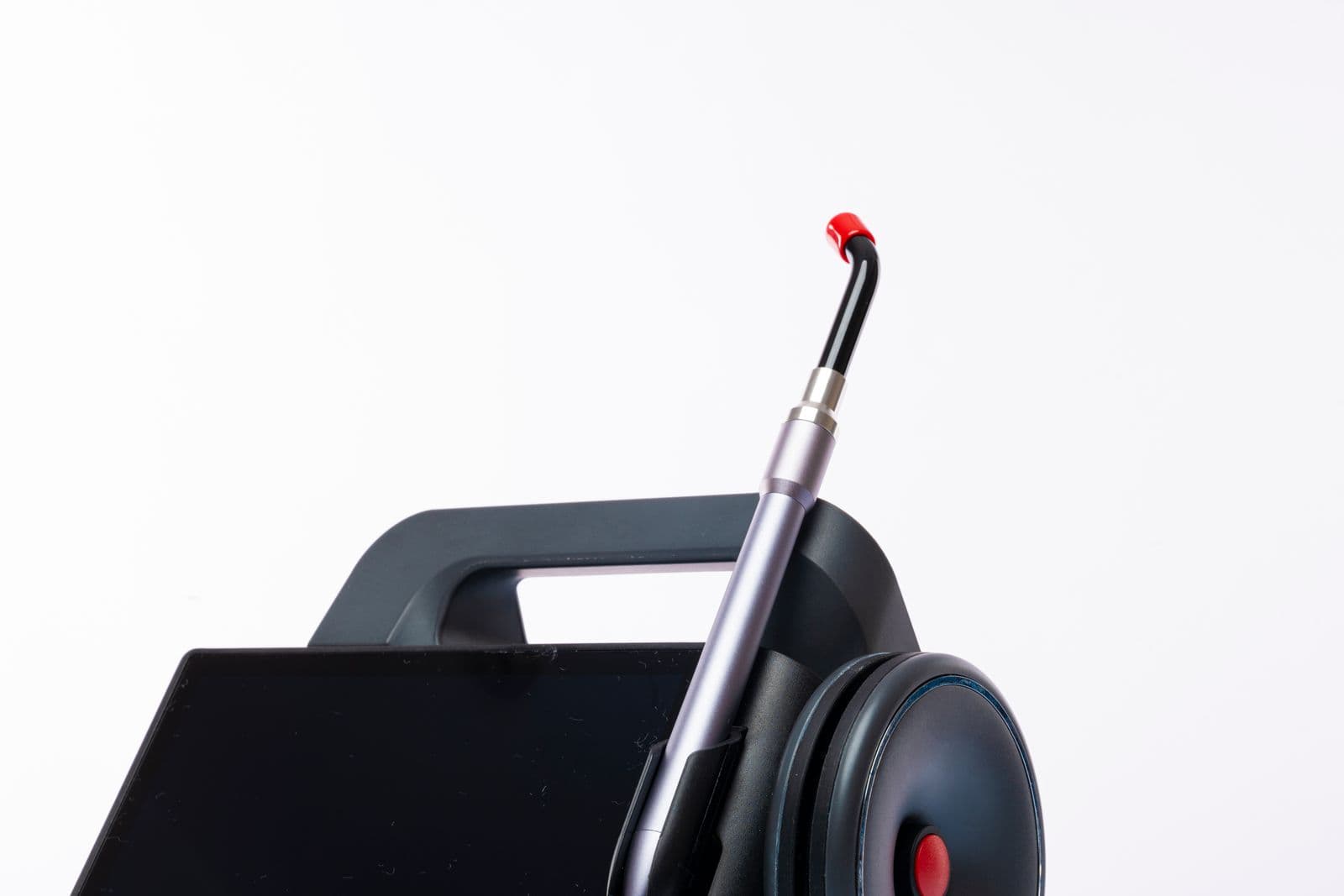
What Is LANAP Laser Gum Surgery?
LANAP laser gum surgery: how the FDA-cleared Nd:YAG laser protocol treats gum disease without cutting or stitches, who it is for, and what the evidence shows.
Have a question about your own teeth?Free
Ask usLANAP (Laser-Assisted New Attachment Procedure) is a minimally invasive laser treatment for gum disease. It uses a free-running pulsed Nd:YAG laser, the PerioLase MVP-7, to remove the diseased tissue lining periodontal pockets and reduce the bacteria inside them, without the incisions and sutures of traditional gum surgery. It is also, according to its manufacturer, the only laser protocol holding an FDA clearance for periodontal regeneration supported by human histologic studies (Millennium Dental Technologies, 2026).
How LANAP works#
### Targeted removal of diseased tissue The 1064 nm Nd:YAG wavelength is absorbed strongly by inflamed, pigmented tissue. A thin optical fiber is passed along the pocket, and the first laser pass strips away the diseased pocket lining while leaving healthy gum tissue essentially intact — selectivity a scalpel cannot offer. Deposits are then cleaned from the root surfaces with ultrasonic and hand instruments.
### Bacteria reduction The same wavelength is absorbed by dark-pigmented periodontal bacteria, so each pass also disinfects the pocket. In a clinical study, LANAP significantly reduced Porphyromonas gingivalis, one of the main pathogens in periodontitis, in treated pockets six weeks after treatment (Bechir, 2023).
### Encouraging reattachment A second laser pass at different settings creates a stable fibrin clot that seals the pocket against the root. The clot acts as a barrier, keeping the outer layer of the gum from growing back down into the pocket, so new connective tissue can attach directly to the root surface rather than the pocket simply being made shallower (Jha, Gupta, and Adinarayan, 2018).
## Who LANAP is for LANAP is typically offered to patients with moderate to advanced periodontitis who have not fully responded to scaling and root planing (deep cleaning), or who want to avoid traditional cut-and-suture gum surgery. Deep pockets, bleeding gums, and loosening teeth are the usual findings. Untreated gum disease progresses to bone loss, and a pocket that closes over an active infection can develop into a periodontal abscess — how to identify an oral abscess covers the warning signs.
## What to expect during treatment - Local anesthesia numbs the treated area; most patients describe pressure or warmth rather than pain - The laser fiber is passed along each pocket to remove diseased tissue - Tartar and deposits are removed from the roots with ultrasonic and hand instruments - A second laser pass forms the sealing clot, and the gums are compressed against the teeth — no stitches are placed - The bite is checked and adjusted where needed, and loose teeth may be splinted
Most full-mouth cases are completed in two sessions about a week or two apart, treating one side of the mouth at a time. Recovery instructions typically favor a soft diet and gentle hygiene around the treated sites.
## What the evidence shows The regeneration claim rests on human histology. Nevins and colleagues treated intrabony defects with the LANAP protocol and examined healed sites microscopically, reporting new cementum, new periodontal ligament, and new bone on previously diseased root surfaces — the three tissues that define true regeneration rather than simple repair (Nevins et al., 2012).
Comparative clinical evidence is early but consistent. In a randomized split-mouth study, both LANAP and scaling and root planing alone improved pockets, plaque, and bleeding at six weeks — pocket depth fell about 44% with LANAP versus about 40% with deep cleaning alone — and LANAP significantly reduced P. gingivalis, though the difference between the two treatments was not statistically significant (Bechir, 2023). A split-mouth, randomized, multi-center trial compared clinical indices after laser or scalpel treatment of periodontitis and reported minimal postoperative discomfort for the laser-treated patients (Harris et al., 2014; Jha et al., 2018).
The balanced verdict comes from the American Academy of Periodontology's 2018 best-evidence consensus panel: human histologic evidence with the Nd:YAG laser is consistent with the potential for regeneration, but current evidence is inadequate to show that laser therapy alone outperforms or matches conventional periodontal therapy, while appropriate adjunctive laser use may provide modest additional benefit (Mills et al., 2018).
## Advantages patients often cite - No cutting and no stitches - Less postoperative discomfort and a faster return to normal activities than flap surgery (Harris et al., 2014; Jha et al., 2018) - Less gum recession than traditional flap surgery in many cases (Jha et al., 2018) - Well accepted by patients in clinical studies (Bechir, 2023)
Frequently asked follow-ups#
### Is LANAP the same as a regular deep cleaning? No. Scaling and root planing is the first-line, non-surgical treatment for gum disease. LANAP is a laser-based protocol used when pockets persist after deep cleaning, or when disease is too advanced for deep cleaning alone.
### Does insurance cover LANAP? Coverage varies by plan. Some insurers process it like other periodontal procedures, while others classify it differently. Ask your insurance provider and the periodontist's office for a pre-treatment estimate.
### How many LANAP sessions are typically needed? Many cases are completed in two sessions about a week or two apart, treating one side of the mouth at a time. Your provider will determine the plan based on the extent of your gum disease.
## Key takeaways - LANAP is an FDA-cleared, minimally invasive laser protocol for moderate to advanced gum disease, performed without cutting or suturing. - The Nd:YAG laser removes the diseased pocket lining, reduces pigmented bacteria, and seals the pocket with a fibrin clot that supports reattachment to the root. - Human histologic studies have documented new cementum, periodontal ligament, and bone on LANAP-treated root surfaces, while the AAP's 2018 consensus notes that comparative evidence remains limited. - Most cases are completed in two sessions about a week or two apart, with less reported discomfort and faster healing than traditional gum surgery.
This article is for general educational purposes and does not replace a personalized evaluation from a periodontist or dental professional.
Ask a dental question
Still have a question?
Free. Answers from published research, then book a visit with a verified local dentist.
Ask a questionCitations
- Nevins, M. L., Camelo, M., Schupbach, P., Kim, S. W., Kim, D. M., & Nevins, M. (2012). Human clinical and histologic evaluation of laser-assisted new attachment procedure. International Journal of Periodontics & Restorative Dentistry, 32(5), 497–507.
- Bechir, E. S. (2023). The clinical and microbiological effects of LANAP compared to scaling and root planing alone in the management of periodontal conditions. Diagnostics, 13(14), 2450.
- Harris, D. M., Nicholson, D. M., McCarthy, D., et al. (2014). Change in clinical indices following laser or scalpel treatment for periodontitis: A split-mouth, randomized, multi-center trial. Proceedings of SPIE, 8929, 89290G.
- Jha, A., Gupta, V., & Adinarayan, R. (2018). LANAP, periodontics and beyond: A review. Journal of Lasers in Medical Sciences, 9(2), 76–81.
- Mills, M. P., Rosen, P. S., Chambrone, L., et al. (2018). American Academy of Periodontology best evidence consensus statement on the efficacy of laser therapy used alone or as an adjunct to non-surgical and surgical treatment of periodontitis and peri-implant diseases. Journal of Periodontology, 89(7), 737–742.
- Millennium Dental Technologies, Inc. (2026). The LANAP Protocol.
About the author
Chithra Durgam, DDS
Guest contributor
Dr. Chithra Durgam is a licensed dentist and guest contributor to Dental Evidence.
More from the blog
- What Should I Do If I Knock Out a Tooth?A knocked-out tooth: handle it by the crown, rinse, replant or store in milk, and see a dentist within 30–60 minutes to save it.
- Am I a Candidate for Invisalign?Invisalign candidacy: aligners suit mild to moderate crowding, spacing, and bite issues, need 20 to 22 hours of daily wear, and healthy gums and bone support.
- Can Adults Get Braces?Adults can get braces at any age: gum and bone health matter more than age, treatment time runs similar to teens, and lifelong retention protects the result.